Learn what AI agent development is, how AI agents work, their business use cases, development process, benefits, challenges, and how businesses can build intelligent AI agent systems.
Artificial Intelligence is moving beyond systems that simply answer questions. Modern AI can understand objectives, reason through problems, use external tools, retrieve information, and perform multi-step tasks with limited human intervention. This evolution has created a new category of software known as AI agents.
AI agent development is the process of designing, building, integrating, deploying, and maintaining intelligent software systems that can understand goals, make decisions, use tools, and execute actions on behalf of users or businesses.
Unlike traditional automation, which follows predefined rules, AI agents can dynamically determine how to complete a task based on context and available information. Businesses can use them for customer support, sales, research, document processing, internal operations, workflow automation, and many other applications.
In this guide, we'll explain what AI agent development means, how AI agents work, the technologies behind them, real-world business use cases, development stages, benefits, challenges, and what organizations should consider before implementing agentic AI.
AI agent development is the process of creating intelligent software agents capable of understanding objectives, reasoning through tasks, accessing information, using digital tools, and taking actions to achieve a desired outcome.
An AI agent typically combines several technologies, including:
The key difference between an AI agent and a basic chatbot is action.
A chatbot may answer a question such as:
"What is the status of my order?"
An AI agent could retrieve the order information, check the customer's account, identify the latest shipment status, and provide the answer without requiring an employee to manually perform those steps.
This makes AI agents particularly valuable for business automation.
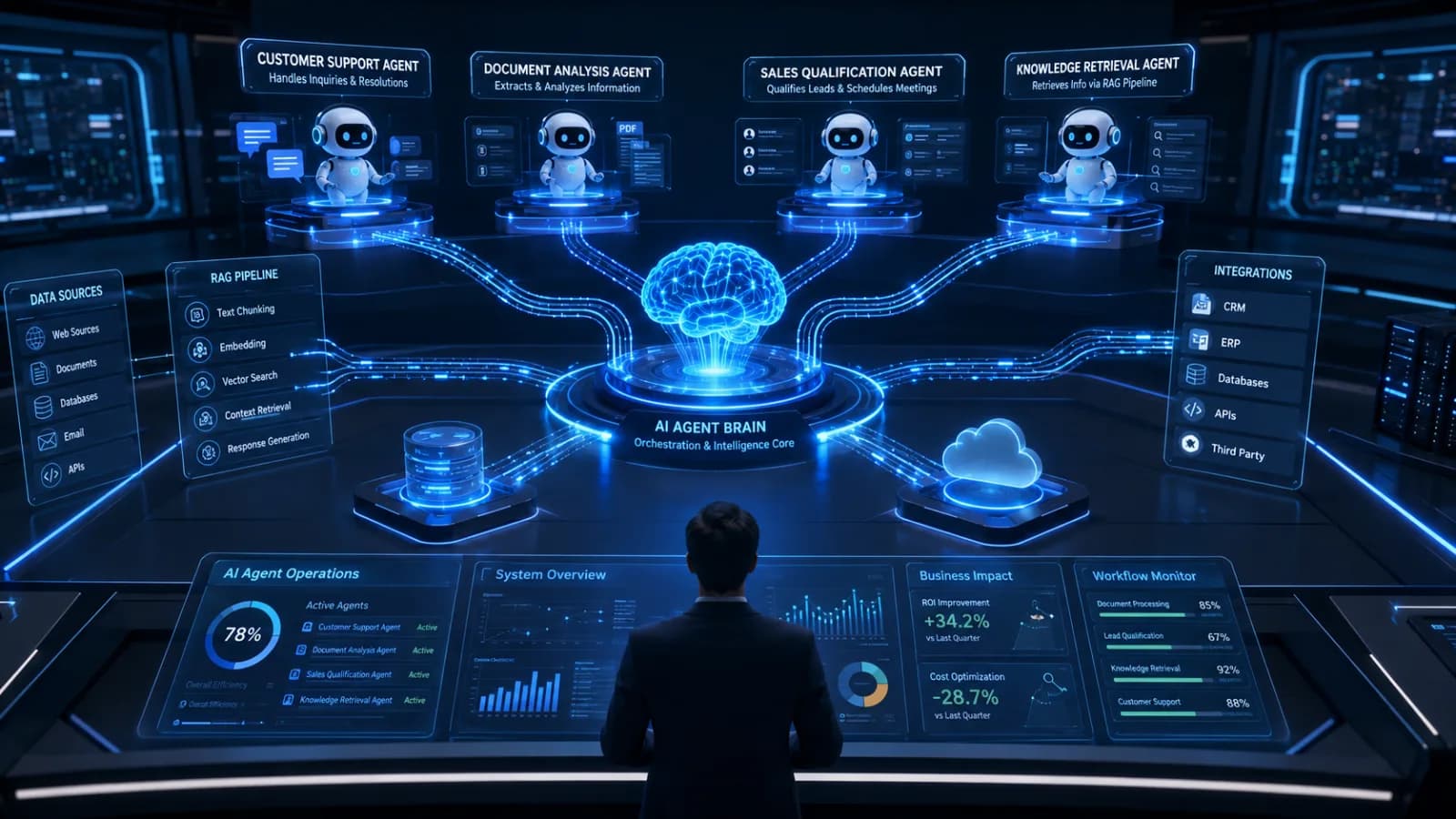
AI agents typically operate through a cycle of understanding, reasoning, tool usage, and action.
A simplified workflow looks like this:
User Provides Goal
        ↓
AI Agent Understands Request
        ↓
Agent Analyzes Context
        ↓
Agent Plans Actions
        ↓
Agent Uses Tools / APIs
        ↓
Agent Retrieves Information
        ↓
Agent Executes Actions
        ↓
Agent Returns Result
The exact architecture varies depending on the application, but most business AI agents contain several important capabilities.
The first step is understanding what the user or business system is asking the agent to accomplish.
Inputs may come from:
Modern AI agents can process multiple types of information depending on the underlying models and architecture.
After receiving an objective, the agent determines what needs to happen next.
For example, a sales agent might receive:
"Find qualified leads from this week's enquiries and prepare follow-up recommendations."
The agent may break this into multiple steps:
This ability to break larger objectives into smaller tasks is one of the defining characteristics of agentic systems.
AI agents become significantly more useful when they can interact with external tools.
Depending on the application, an agent may access:
Instead of simply generating text, the agent can use these tools to retrieve information and perform actions.
Memory allows an AI agent to maintain relevant information across interactions.
Depending on the architecture, memory may include:
Memory helps agents provide more contextual responses and maintain continuity throughout complex workflows.
The final stage is taking action.
An AI agent might:
This action-oriented capability is what makes AI agents particularly powerful for business automation.
AI agents and traditional chatbots are not the same.
A traditional chatbot generally responds to predefined questions or conversational prompts.
An AI agent can reason about a goal and perform multiple actions to achieve it.
| Capability | Traditional Chatbot | AI Agent |
|---|---|---|
| Answer questions | Yes | Yes |
| Context awareness | Limited to moderate | Advanced |
| Tool usage | Limited | Extensive |
| Multi-step tasks | Limited | Yes |
| API integration | Sometimes | Core capability |
| Autonomous actions | Limited | Yes |
| Workflow automation | Basic | Advanced |
| Decision-making | Rule-based | Context-driven |
For simple customer questions, a chatbot may be sufficient.
For complex workflows involving multiple systems and actions, AI agents can provide significantly greater value.
Building an effective AI agent requires more than connecting an application to an LLM.
Several technical components work together.
Large Language Models provide the reasoning and language capabilities behind many modern AI agents.
Depending on the application, businesses may use different models based on:
The largest model isn't always the best choice.
For narrowly defined business tasks, a smaller and optimized model may provide better economics while delivering sufficient performance.
Agent orchestration controls how different tasks and components interact.
An orchestration layer can determine:
Complex systems may use multiple specialized agents working together.
AI agents often need access to business-specific information.
Retrieval-Augmented Generation (RAG) allows agents to retrieve relevant information from sources such as:
This helps agents provide responses grounded in business information rather than relying only on general model knowledge.
Memory allows agents to maintain useful context throughout a workflow.
A customer service agent, for example, may need to remember:
Memory architecture should be carefully designed so that the system stores and retrieves only relevant information.
Tools give AI agents the ability to interact with external systems.
Common integrations include:
API connectivity transforms AI from a conversational interface into an operational business system.
Production AI agents require monitoring and security from the beginning.
Businesses should monitor:
Security controls should include appropriate authentication, authorization, data protection, and access restrictions.
AI systems that interact with business tools should also have clearly defined permissions and human approval requirements for sensitive actions.
AI agents can support a wide range of business functions because they can combine reasoning, knowledge retrieval, system integrations, and automated actions.
The most valuable applications are usually workflows where employees repeatedly gather information, make routine decisions, and perform actions across multiple systems.
AI agents can handle more than answering frequently asked questions.
A customer support agent can:
This allows businesses to provide faster support while reducing the workload on customer service teams.
AI agents can help sales teams manage large volumes of leads.
A sales agent can:
Instead of manually moving information between systems, sales teams can allow AI agents to manage repetitive parts of the sales workflow.
AI agents can automate workflows that traditionally require multiple manual steps.
Examples include:
Agentic automation is particularly useful when workflows involve changing conditions rather than simple fixed rules.
Employees often spend significant time searching through documents, emails, policies, and internal systems.
An AI knowledge agent can provide a natural-language interface to company information.
Employees can ask:
The agent retrieves relevant information and presents it in a useful format.
Businesses process large numbers of documents every day.
AI agents can help automate:
When combined with document intelligence and workflow automation, agents can move information from unstructured documents into operational systems.
AI agents can assist teams with research-intensive workflows.
A research agent can:
This can reduce the time employees spend on repetitive research and information gathering.
AI agents can also support internal technical teams.
Potential applications include:
Agents can help technical teams resolve routine issues faster while escalating more complex problems to specialists.
Organizations implementing AI agents can achieve benefits across productivity, operations, customer experience, and scalability.
AI agents automate repetitive tasks and reduce the amount of manual work employees need to perform.
Teams can spend more time on:
The objective is not simply automation, but better allocation of human expertise.
Automating repetitive workflows can reduce the amount of time and resources required to complete routine business activities.
AI agents can work continuously without requiring the same level of manual intervention as traditional processes.
This can improve operational efficiency as transaction volumes increase.
AI agents can retrieve information, analyze context, and provide recommendations much faster than manual workflows.
Businesses can use agents to support decisions involving:
Human oversight remains important for high-impact decisions, but agents can significantly accelerate information gathering and analysis.
Unlike human teams, software agents can operate continuously.
This enables businesses to provide:
24/7 availability can be especially valuable for businesses serving customers across different time zones.
AI agents can provide personalized and context-aware interactions.
They can access relevant customer information and perform actions instead of simply providing generic responses.
This creates faster and more useful digital experiences.
Traditional operations often require additional employees as workload increases.
AI agents can handle growing volumes of routine tasks without requiring a proportional increase in manual effort.
This makes agentic systems particularly valuable for growing businesses.
Building a reliable AI agent requires careful planning and engineering.
The first step is understanding the business problem.
Teams should identify:
The goal is to identify where an AI agent can provide measurable value.
Not every process needs an AI agent.
Good candidates typically involve:
The selected use case should have clear success metrics.
Once the use case is defined, developers design the agent architecture.
This may include:
Architecture should be based on business requirements rather than technology trends.
Developers then build the agent's reasoning and execution workflows.
This includes:
The system should be designed to behave predictably within clearly defined boundaries.
The agent is connected to the business systems it needs to access.
These may include:
Secure API integration allows the agent to perform meaningful business actions.
AI agents require extensive testing because their outputs can vary depending on context.
Testing should evaluate:
High-risk actions should include appropriate validation or human approval.
After deployment, the agent should be continuously monitored.
Important metrics include:
Continuous monitoring helps identify failures and opportunities for improvement.
AI agents offer significant potential, but businesses should understand their limitations.
AI models can sometimes generate incorrect information.
Businesses should reduce this risk through:
Critical business decisions should not depend entirely on unverified AI output.
AI agents may interact with sensitive business information.
Organizations should carefully control:
Least-privilege access and strong authentication are essential for production systems.
Connecting an AI agent to multiple business systems can introduce technical complexity.
Each integration requires:
A well-designed architecture is essential for reliable operation.
AI agent costs can increase when systems perform large numbers of model calls, retrieval operations, or API actions.
Businesses should monitor:
Choosing the appropriate model and architecture can significantly improve operating economics.
Autonomous does not always mean unsupervised.
Sensitive workflows may require humans to approve actions involving:
Human-in-the-loop controls provide an additional layer of safety and accountability.
Businesses should follow several principles when developing production AI agents.
The strongest AI agents are not necessarily the most autonomous. They are the ones that reliably perform the right tasks within clearly defined boundaries.
Traditional automation follows predefined rules.
AI agents introduce a more flexible approach in which software can interpret context, decide what steps are required, and use available tools to complete a goal.
This creates opportunities for agentic automation across complex business workflows.
For example, instead of creating separate automation rules for every possible customer request, an AI agent can understand the request, retrieve the necessary information, determine the appropriate workflow, and take permitted actions.
As agent technology matures, businesses will increasingly combine traditional automation, AI agents, APIs, and human expertise into unified digital workflows.
An AI agent may be appropriate when a business has a workflow that:
Businesses should avoid building agents simply because AI is trending.
The strongest use cases are connected to measurable business outcomes such as reduced processing time, lower support costs, faster lead response, or improved employee productivity.
At MYST International, we help startups, SMEs, and enterprises design and develop AI agent systems that solve practical business problems.
Our capabilities include:
We begin with the business problem rather than the technology.
Our team evaluates workflows, data, integrations, security requirements, and expected outcomes before designing an AI agent architecture.
The result is a practical, scalable AI solution designed to work within real business environments.
AI agent development represents an important evolution in business software. Instead of simply generating answers, AI agents can understand objectives, retrieve information, use tools, make contextual decisions, and execute multi-step workflows.
For businesses, this creates opportunities to automate complex processes, improve productivity, accelerate customer service, and scale operations more efficiently.
However, successful AI agent implementation requires more than connecting an application to an LLM. Businesses need thoughtful architecture, reliable data, secure integrations, monitoring, testing, and appropriate human oversight.
The most valuable AI agents are built around real business problems with clearly defined outcomes. When implemented strategically, agentic AI can become a powerful layer of modern business automation and a long-term competitive advantage.
At MYST International, we help businesses turn AI opportunities into production-ready agent systems that integrate with existing technology, automate meaningful workflows, and create measurable business value.
AI agent development is the process of designing, building, integrating, deploying, and maintaining intelligent software agents that can understand goals, reason through tasks, use tools and APIs, retrieve information, and take actions on behalf of users or businesses.
Traditional chatbots primarily answer questions or follow predefined conversational flows. AI agents can understand goals, reason through multi-step tasks, access external systems, use tools and APIs, and execute actions with appropriate permissions.
Businesses can use AI agents for customer support, sales and lead qualification, workflow automation, knowledge management, document processing, research, data analysis, IT support, and internal business operations.
AI agent development costs vary depending on the complexity of the workflow, AI models, integrations, data requirements, security controls, infrastructure, and deployment requirements. A simple internal agent generally costs less than a multi-agent enterprise system with extensive integrations.
Yes. AI agents can integrate with CRM systems, ERP platforms, databases, email services, calendars, payment systems, internal applications, and other business software through APIs and secure integrations.
AI agents can be deployed securely when businesses implement appropriate authentication, authorization, data protection, access controls, monitoring, and human approval for sensitive actions. Agents should only receive the permissions required to perform their assigned tasks.
Businesses should consider an AI agent when a workflow involves repetitive manual work, information retrieval, multiple applications, natural-language inputs, contextual decision-making, or measurable operational costs that can be reduced through intelligent automation.
AI agents are primarily designed to automate repetitive tasks and assist employees. Human oversight remains important for complex, sensitive, or high-impact decisions, while employees can focus on strategy, creativity, customer relationships, and other high-value activities.