
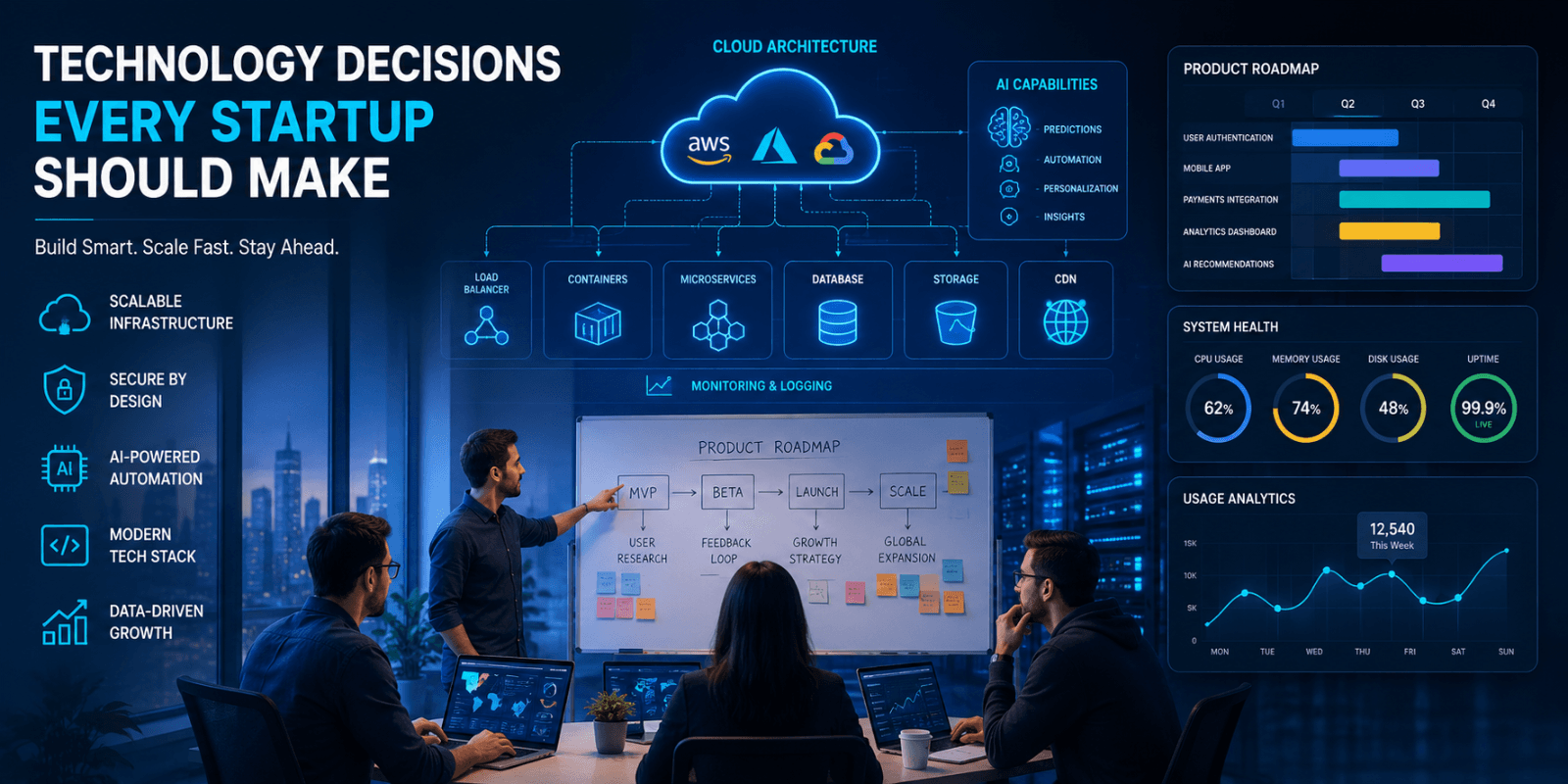
Discover the most important technology decisions every startup should make before scaling. Learn how to build scalable products, choose the right technology stack, improve security, and prepare your startup for sustainable long-term growth.
Technology Decisions Every Startup Should Make Before Scaling
Every successful startup begins with a great idea, but turning that idea into a sustainable business requires much more than passion, funding, and hard work. One of the most important factors that determines whether a startup can grow successfully is the quality of its technology decisions.
Many startups focus almost entirely on launching products quickly and acquiring customers. While speed is important, rushing technology decisions often creates problems that become expensive to solve later. Poor architecture, weak security, unscalable infrastructure, and accumulating technical debt can slow product development, frustrate customers, and increase operational costs just when the business is beginning to grow.
The good news is that these challenges are largely preventable.
By making thoughtful technology decisions early, founders can create products that are secure, scalable, and ready to support long-term business growth. Technology should never be viewed as simply writing code—it is a strategic investment that influences every part of the business, from customer experience and operational efficiency to investor confidence and future innovation.
In this guide, we’ll explore the most important technology decisions every startup should make before scaling and explain how these decisions create a stronger foundation for sustainable success.
⸻
Why Technology Decisions Matter for Startups
Technology influences nearly every aspect of a startup.
The decisions made during the first year affect:
Good technology decisions help startups:
Poor decisions often result in expensive redevelopment projects, technical debt, and slower business growth.
Instead of viewing technology as a cost, successful startups treat it as a long-term competitive advantage.
⸻
One of the most common startup mistakes is building a complete product before confirming that customers actually want it.
Many founders spend months developing software based on assumptions instead of real customer feedback.
Before investing heavily in development, every startup should answer three important questions:
Validating these assumptions early reduces risk and prevents wasted development effort.
⸻
Why Validation Matters
Product development is expensive.
Building features that customers never use wastes valuable time and resources.
Validation helps startups understand:
The earlier these insights are gathered, the better the final product becomes.
⸻
Practical Validation Methods
Startups don’t need fully developed software to validate ideas.
Instead, they can use:
Collecting feedback before development begins allows founders to make informed decisions rather than relying on assumptions.
⸻
Rather than launching a feature-rich platform immediately, startups should begin with a Minimum Viable Product (MVP).
An MVP focuses on solving one important customer problem exceptionally well.
Instead of including every possible feature, the product contains only the essential functionality required to deliver value.
Benefits of an MVP include:
Launching early allows startups to improve based on real user behavior rather than internal opinions.
⸻
Benefits of an MVP
Successful startups treat the first version as the beginning—not the finished product.
An MVP enables teams to:
Continuous improvement creates better products than attempting to perfect everything before launch.
⸻
Avoiding Feature Creep
Feature creep occurs when teams continue adding functionality before validating existing features.
Common symptoms include:
The best products remain focused on solving a specific customer problem.
Additional features should only be introduced after customer demand has been validated.
⸻
Selecting the right technology stack is one of the most important decisions a startup makes.
The technology stack determines:
Rather than selecting technologies because they are popular, startups should evaluate how well they support business goals.
⸻
Frontend Technologies
Modern frontend frameworks help build responsive, engaging user experiences.
Popular choices include:
These frameworks support fast development while providing excellent performance and scalability.
⸻
Backend Technologies
Backend systems manage business logic, authentication, APIs, and data processing.
Common technologies include:
Each option offers unique advantages depending on product requirements and development expertise.
⸻
Databases
The database stores one of the startup’s most valuable assets—its data.
Popular options include:
Choosing the right database depends on application complexity, scalability requirements, and expected workloads.
⸻
Cloud Platforms
Cloud infrastructure enables startups to launch quickly while avoiding large upfront hardware investments.
Leading providers include:
Cloud platforms provide scalability, security, global availability, and flexible pricing that support growing businesses.
⸻
Most startups launch with relatively few users.
However, successful products can experience rapid growth.
If the underlying technology isn’t designed to scale, increased demand may lead to:
Scalability doesn’t mean building unnecessarily complex systems.
It means designing architecture that can grow efficiently as the business expands.
Founders should consider:
Planning for growth early significantly reduces future redevelopment costs.
⸻
Security should never be postponed until after launch.
Even early-stage startups often manage:
A security incident can damage customer trust while creating legal and financial risks.
Essential security practices include:
Building secure systems from the beginning is significantly easier than attempting to fix vulnerabilities later.
⸻
Data is one of the most valuable assets a startup owns.
Every customer interaction generates information that can improve products, marketing, and business decisions.
Before launching, startups should define:
A well-planned data strategy enables future automation, business intelligence, and Artificial Intelligence initiatives while maintaining privacy and compliance.
Modern applications rarely operate in isolation.
As your startup grows, your product will likely need to integrate with third-party platforms and internal systems.
Common integrations include:
Building with APIs in mind from the beginning makes future integrations significantly easier.
An API-first architecture also improves flexibility, allowing your product to evolve without requiring major redevelopment.
⸻
Even the most innovative product can struggle if users find it confusing or difficult to use.
A great user experience encourages customers to stay longer, engage more frequently, and recommend your product to others.
Important UX considerations include:
Successful startups regularly collect user feedback and improve their products based on real customer behavior rather than internal assumptions.
Remember that customers evaluate experiences—not technology stacks.
⸻
As startups grow, manual processes quickly become bottlenecks.
Tasks that seem manageable with five employees become increasingly difficult with fifty.
Automation helps startups improve efficiency without proportionally increasing headcount.
Processes that are commonly automated include:
Automation allows teams to spend more time solving customer problems and less time performing repetitive administrative work.
⸻
Modern startups benefit significantly from cloud-native infrastructure.
Instead of investing heavily in physical servers, cloud platforms provide flexible resources that grow alongside the business.
Cloud platforms offer advantages such as:
Popular cloud providers include:
Choosing cloud infrastructure early makes scaling significantly easier while reducing operational complexity.
⸻
Founders cannot improve what they don’t measure.
Monitoring systems provide valuable insights into how products perform and how customers interact with them.
Important metrics include:
Modern monitoring tools also help engineering teams identify technical issues before they affect customers.
Making decisions based on real data leads to better products and more efficient business operations.
⸻
Successful startups never consider their products “finished.”
Markets evolve.
Customer expectations change.
Technology advances.
Competitors introduce new features.
The most successful startups embrace continuous improvement.
This includes:
Small, consistent improvements often produce greater long-term success than occasional major redesigns.
⸻
Common Technology Mistakes Startups Should Avoid
Many startups encounter similar challenges during their growth journey.
Common mistakes include:
Recognizing these challenges early helps founders avoid costly redevelopment projects while accelerating business growth.
⸻
A Practical Technology Roadmap
A phased approach helps startups make smarter technology investments.
Idea Stage
Focus on validating the business opportunity.
Activities include:
⸻
MVP Stage
Build the smallest product capable of delivering customer value.
Priorities include:
⸻
Growth Stage
As adoption increases, startups should strengthen the product by:
⸻
Scaling Stage
Once the business demonstrates consistent growth, technology investments should focus on:
Following a structured roadmap helps startups invest in the right technology at the right time.
⸻
Why Technology Decisions Influence Investor Confidence
Investors evaluate far more than innovative ideas.
They also assess whether a startup has the technical foundation necessary for long-term success.
Businesses with:
often appear significantly more attractive to investors.
A well-designed technology foundation demonstrates that founders are preparing for sustainable growth rather than short-term success.
⸻
Why Startups Choose MYST International
At MYST International, we work with startups from the earliest stages of product development through large-scale growth.
Our approach focuses on creating technology that supports long-term business success instead of short-term fixes.
Our startup services include:
We help founders make strategic technology decisions that reduce development risk, improve scalability, and prepare products for future growth.
By combining business understanding with engineering expertise, we build digital products that are secure, scalable, and ready for the next stage of growth.
⸻
Final Thoughts
The technology decisions made during a startup’s early stages often determine how successfully the business can scale in the future. While launching quickly is important, building on a strong technical foundation is equally essential. Founders who prioritize validation, scalable architecture, security, cloud infrastructure, automation, data strategy, and exceptional user experience create products that can adapt to changing customer needs and growing market demands.
Technology should never be viewed as simply writing code—it is a strategic investment that influences every aspect of a startup’s success. By making thoughtful decisions early and continuously improving over time, startups can reduce risk, attract investors, accelerate growth, and build products that remain competitive in an increasingly digital world.
At MYST International, we help startups transform ambitious ideas into scalable, future-ready digital products through expert technology consulting, custom software development, AI integration, and modern cloud-native engineering.
Technology decisions affect scalability, security, customer experience, operational efficiency, and long-term development costs.
Startups should validate their idea, build an MVP, choose a scalable technology stack, and implement strong security before expanding features.
Most startups benefit from combining reliable third-party tools with custom software for features that provide a competitive advantage.
Startups should implement AI when it solves a clear business problem such as automation, customer support, analytics, or workflow optimization.
By choosing scalable architecture, cloud infrastructure, secure systems, APIs, monitoring tools, and continuously improving the product based on user feedback.