Discover how Retrieval-Augmented Generation (RAG) and AI Agents help businesses build intelligent applications, automate workflows, improve customer support, and unlock the full value of enterprise knowledge.
Artificial Intelligence has evolved far beyond simple chatbots and text generation tools. Modern businesses need AI systems that understand their internal knowledge, interact with business applications, make intelligent decisions, and execute complex workflows with minimal human intervention.
This is where Retrieval-Augmented Generation (RAG) and AI Agents are transforming enterprise software.
Traditional Large Language Models rely primarily on the information available during their training. While they are remarkably capable, they may generate outdated or inaccurate responses when asked about business-specific information. RAG solves this problem by allowing AI to retrieve relevant information from trusted business documents, databases, knowledge bases, and internal systems before generating an answer.
AI Agents take this capability even further. Rather than simply responding to questions, they can reason through problems, create execution plans, interact with APIs, retrieve information, automate workflows, and complete business tasks autonomously.
Together, RAG and AI Agents enable organizations to build intelligent digital assistants capable of improving customer support, increasing employee productivity, automating operations, and unlocking the full value of enterprise knowledge.
In this guide, we'll explore how RAG and AI Agents work, their business applications, implementation best practices, and why partnering with an experienced RAG & AI Agent Development Company is essential for building secure, scalable, and production-ready AI solutions.
Retrieval-Augmented Generation (RAG) is an AI architecture that combines the reasoning capabilities of Large Language Models (LLMs) with external business knowledge.
Instead of relying only on pre-trained information, a RAG system searches trusted company resources before generating a response.
These knowledge sources may include:
Because responses are grounded in verified business information, RAG systems provide:
For organizations managing large volumes of documentation, RAG dramatically improves knowledge accessibility while ensuring employees and customers receive reliable information.
An AI Agent is an intelligent software system capable of understanding objectives, reasoning about tasks, using digital tools, and completing workflows autonomously.
Unlike traditional chatbots that simply answer questions, AI agents actively perform work.
Typical capabilities include:
Think of an AI Agent as a digital employee capable of executing business processes rather than simply participating in conversations.
As AI models become more capable, intelligent agents are becoming central components of enterprise automation strategies.
RAG and AI Agents complement one another.
RAG provides accurate business knowledge.
AI Agents use that knowledge to make decisions and complete actions.
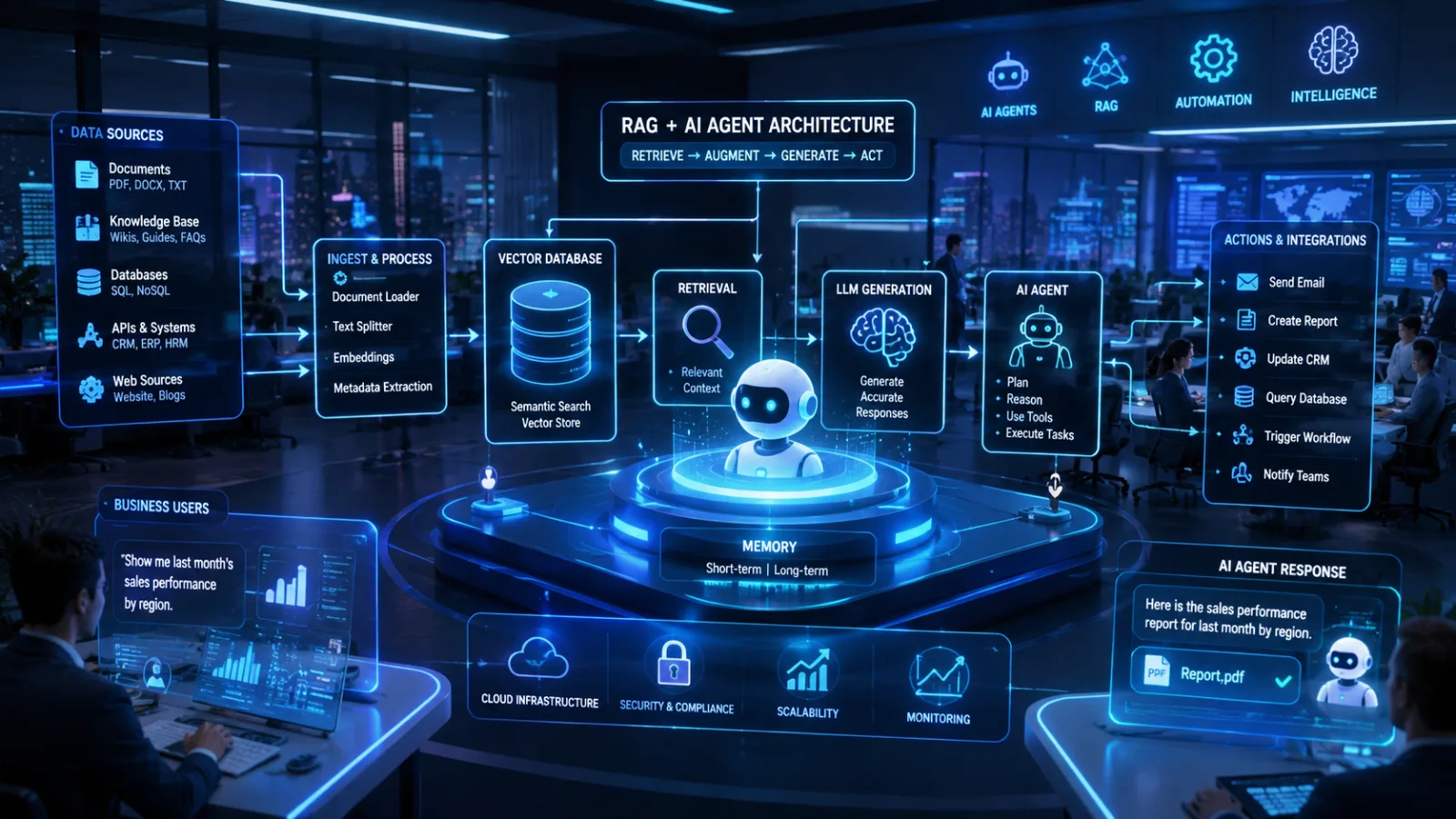
A typical workflow follows these steps:
User Request

↓

AI Agent Understands Intent

↓

Retrieve Relevant Business Knowledge (RAG)

↓

Reason About the Task

↓

Use Business Applications & APIs

↓

Execute Actions

↓

Generate Accurate Response
For example, imagine a finance manager asks:
"Generate last month's sales report, summarize key trends, and email it to the leadership team."
A RAG-powered AI Agent can:
This level of intelligent automation goes far beyond the capabilities of conventional chatbots.
Organizations increasingly require AI systems that understand their own business rather than relying solely on public internet knowledge.
RAG-powered AI Agents provide significant operational advantages.
Businesses use them to:
Instead of searching through hundreds of documents or waiting for colleagues to respond, employees can simply ask an AI assistant.
The result is faster work, better decisions, and greater organizational productivity.
Building enterprise-grade AI solutions requires several technologies working together.
The Large Language Model acts as the reasoning engine.
It understands requests, analyzes retrieved information, and generates natural language responses.
Popular enterprise models include:
Each model offers different strengths depending on business requirements, security considerations, and deployment preferences.
The knowledge base stores trusted business information.
Typical sources include:
Unlike traditional AI, RAG systems continuously retrieve information from these sources whenever users submit requests.
This ensures responses remain current as business knowledge evolves.
Documents cannot be searched effectively using traditional keyword matching alone.
Embedding models convert text into numerical representations called vectors.
These vectors capture semantic meaning rather than exact wording.
As a result, users receive relevant answers even when they ask questions differently from how documents were originally written.
Semantic search dramatically improves information retrieval accuracy.
Embeddings are stored inside specialized vector databases.
Popular options include:
Unlike conventional databases, vector databases retrieve information based on meaning instead of exact keyword matches.
This allows AI systems to find the most relevant business knowledge almost instantly.
The retrieval engine connects user questions with relevant knowledge.
Its responsibilities include:
Only after this retrieval process does the AI generate its final response.
This grounding process greatly improves factual accuracy while reducing hallucinations.
AI Agent frameworks coordinate reasoning and task execution.
Popular frameworks include:
These frameworks allow intelligent agents to:
They provide the orchestration layer that transforms conversational AI into intelligent automation.
Enterprise AI Agents become significantly more valuable when connected to existing business systems.
Common integrations include:
These integrations enable AI to complete meaningful business tasks instead of simply providing information.
Organizations across industries are using RAG-powered AI Agents to automate knowledge work and improve operational efficiency.
AI agents provide instant support by retrieving accurate answers from product documentation, troubleshooting guides, and company policies.
Benefits include:
Employees frequently spend valuable time searching for information.
AI knowledge assistants allow staff to instantly access:
Instead of searching manually, employees receive immediate, context-aware answers.
Sales teams spend a significant amount of time researching prospects, preparing proposals, updating CRM records, and responding to customer inquiries. A RAG-powered AI agent streamlines these activities by retrieving relevant customer information and automating repetitive tasks.
AI sales agents can:
By reducing administrative work, sales teams can spend more time building relationships and closing deals.
Healthcare organizations manage enormous volumes of sensitive information.
RAG-powered AI assistants help medical professionals quickly retrieve trusted information from:
Healthcare organizations benefit through:
Human oversight remains essential, but AI significantly improves operational efficiency.
Legal professionals spend considerable time reviewing contracts, researching regulations, and analyzing case documents.
RAG-powered AI systems assist by:
This allows legal teams to work more efficiently while maintaining high standards of accuracy.
Financial organizations use AI agents to improve operational efficiency and decision-making.
Common applications include:
By retrieving accurate financial information and automating repetitive tasks, AI agents reduce manual effort while improving accuracy.
Organizations implementing RAG-powered AI agents experience measurable business improvements across multiple departments.
Traditional AI models sometimes generate incorrect or outdated information.
RAG systems retrieve trusted business knowledge before generating responses, producing answers that are:
This significantly reduces misinformation and improves user trust.
One of the biggest concerns with Large Language Models is hallucination—the generation of information that sounds convincing but is incorrect.
Because RAG grounds responses in verified business data, hallucinations are dramatically reduced.
This makes enterprise AI more dependable for business-critical applications.
Employees no longer need to search through multiple systems or documents to find information.
AI agents retrieve answers instantly, enabling:
Knowledge becomes immediately accessible across the organization.
AI agents automate repetitive administrative work such as:
Employees can focus on strategic work that creates greater business value.
Customers expect quick, accurate, and personalized service.
AI agents improve customer experiences through:
Satisfied customers are more likely to remain loyal and recommend the business.
As organizations grow, managing internal knowledge becomes increasingly difficult.
RAG systems centralize information while allowing employees to retrieve answers naturally through conversation.
Instead of navigating multiple applications, users simply ask questions.
Knowledge becomes searchable, accessible, and continuously updated.
Although RAG-powered AI agents offer significant advantages, successful implementation requires careful planning.
Organizations commonly encounter challenges such as:
Addressing these challenges early helps ensure long-term project success.
Organizations should follow proven practices when developing enterprise AI solutions.
Identify specific workflows and business problems before selecting technologies.
Organize documentation, remove duplicate content, and maintain accurate business information.
Design systems capable of supporting increasing users, expanding datasets, and future integrations.
Protect sensitive business information using:
Monitor:
Continuous optimization improves long-term AI performance.
Building production-ready enterprise AI requires expertise across multiple disciplines.
A specialized development company provides:
Rather than experimenting with disconnected AI tools, businesses receive scalable solutions aligned with long-term objectives.
At MYST International, we specialize in building production-ready AI systems that help organizations transform knowledge into intelligent business capabilities.
Our expertise includes:
We partner with startups, SMEs, and enterprises to design secure, scalable, and future-ready AI solutions that solve real business challenges.
From strategy and architecture to deployment and continuous optimization, our team delivers AI systems that improve productivity, automate workflows, and create measurable business value.
Retrieval-Augmented Generation and AI Agents represent the next generation of enterprise Artificial Intelligence. By combining trusted business knowledge with intelligent reasoning and autonomous task execution, organizations can move beyond simple chatbots toward AI systems that actively support business operations.
Whether improving customer support, empowering employees with instant knowledge, automating complex workflows, or integrating seamlessly with existing business systems, RAG-powered AI agents are becoming a critical component of modern digital transformation strategies.
Businesses that invest in these technologies today will be better prepared to compete in an increasingly AI-driven economy. By partnering with an experienced RAG & AI Agent Development Company like MYST International, organizations can build secure, scalable, and intelligent AI solutions that deliver long-term operational efficiency, innovation, and sustainable business growth.
A RAG-based AI system combines a Large Language Model (LLM) with external knowledge sources, allowing it to retrieve relevant business information before generating accurate, context-aware responses.
A chatbot mainly answers questions, while an AI agent can reason, plan, retrieve information, use business tools, integrate with APIs, and complete multi-step workflows autonomously.
Healthcare, finance, legal services, retail, manufacturing, education, logistics, and customer support organizations benefit significantly from RAG-powered AI solutions.
Yes. AI agents can integrate with CRM platforms, ERP systems, cloud storage, communication tools, databases, and APIs to automate business workflows.
Custom development ensures AI understands your organization's knowledge, follows business workflows, integrates with existing systems, and meets security, compliance, and scalability requirements.