
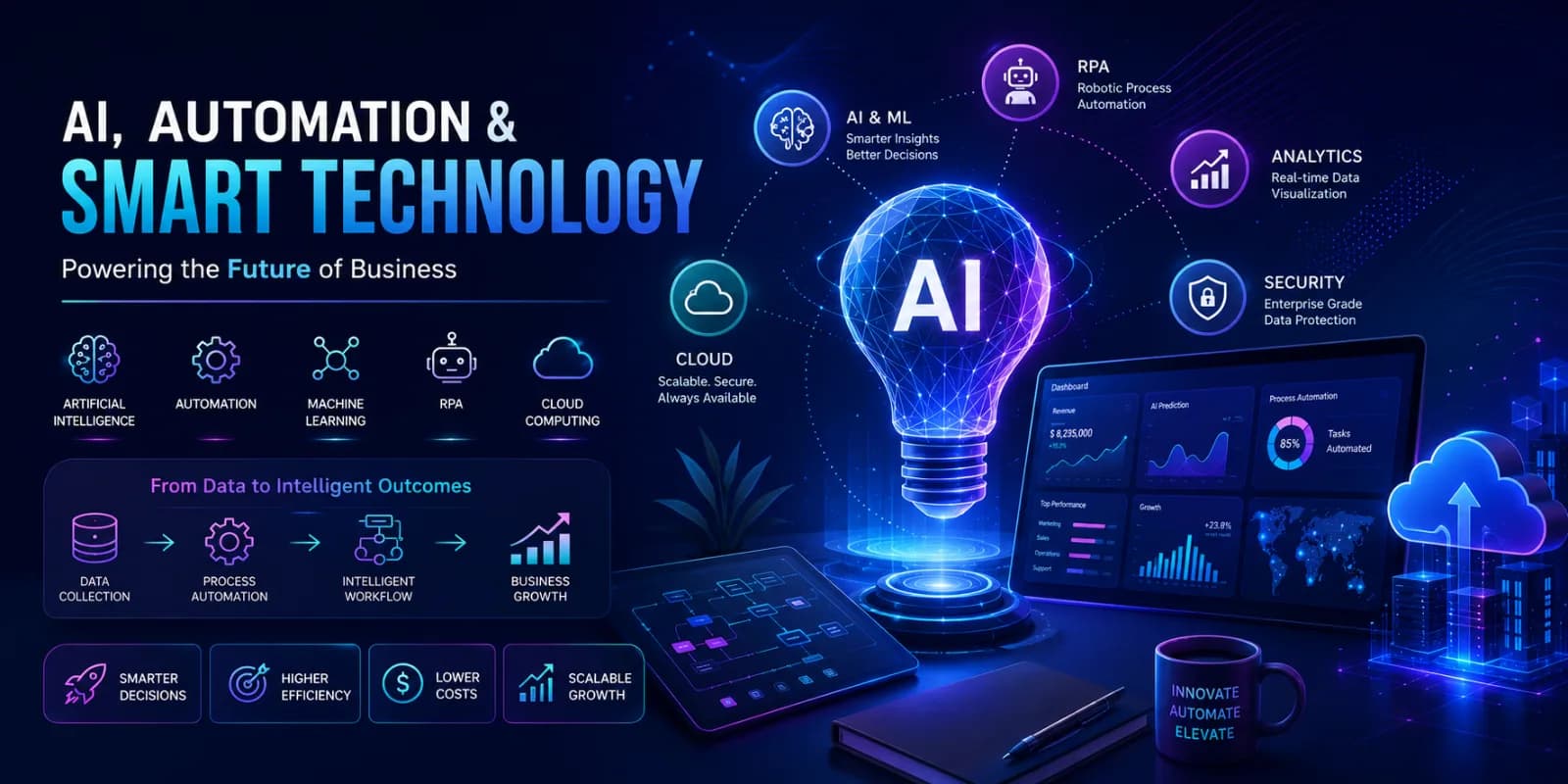
Discover how Artificial Intelligence is transforming businesses through automation, customer experience, predictive analytics, and intelligent decision-making. Learn practical AI use cases, benefits, challenges, and implementation strategies for sustainable business growth.
Artificial Intelligence (AI) is no longer a futuristic concept reserved for technology companies or research laboratories. It has become one of the most important business technologies of the modern era, helping organizations improve productivity, automate repetitive tasks, deliver exceptional customer experiences, and make faster, data-driven decisions.
Businesses of every size—from startups and small businesses to global enterprises—are integrating AI into their daily operations. Whether it's an AI-powered chatbot assisting customers, a recommendation engine personalizing shopping experiences, or predictive analytics forecasting future demand, AI is changing how organizations compete in an increasingly digital economy.
Unlike traditional software, which follows predefined instructions, AI systems learn from data, recognize patterns, and continuously improve over time. This allows businesses to automate complex processes while adapting to changing customer needs and market conditions.
The result is greater efficiency, lower operational costs, better decision-making, and stronger competitive advantages.
In this guide, we'll explore how AI is transforming businesses, the technologies behind it, practical use cases across industries, key benefits, implementation challenges, and the strategies organizations can use to successfully adopt Artificial Intelligence.
Artificial Intelligence in business refers to using intelligent software systems that can perform tasks traditionally requiring human intelligence.
Instead of relying entirely on fixed rules, AI systems analyze data, learn from experience, and improve their performance over time.
Modern AI systems help businesses perform tasks such as:
Rather than replacing employees, AI enhances human capabilities by handling repetitive work while allowing people to focus on creative, strategic, and customer-focused activities.
Organizations that successfully integrate AI often become more productive while improving customer satisfaction and operational efficiency.
Artificial Intelligence has rapidly moved from experimental projects to essential business infrastructure.
Organizations invest in AI because it delivers measurable business value.
Key advantages include:
Businesses that adopt AI strategically can respond faster to market changes while improving the quality of products and services.
Instead of simply reducing costs, AI enables organizations to innovate more quickly and create entirely new business opportunities.
Artificial Intelligence is creating value across nearly every department within modern organizations.
Customer support has become one of the most visible applications of Artificial Intelligence.
Modern AI-powered chatbots and virtual assistants can:
Unlike traditional rule-based chatbots, modern AI assistants understand natural language and provide more personalized conversations.
This improves customer satisfaction while allowing human support teams to focus on more complex cases.
AI is helping sales teams become more productive by automating repetitive work and improving decision-making.
Businesses use AI to:
Instead of spending hours reviewing spreadsheets, sales representatives receive actionable insights that help them focus on the most promising opportunities.
Marketing has become increasingly data-driven, making AI one of the most valuable tools for modern marketing teams.
Artificial Intelligence supports:
Businesses can deliver more relevant messages to customers while reducing the time required to create and optimize marketing campaigns.
AI also helps organizations identify customer interests, predict purchasing behavior, and improve conversion rates.
Human Resources departments increasingly rely on AI to improve recruitment and employee management.
Common AI applications include:
AI reduces administrative work while helping HR professionals make more informed hiring decisions.
Financial departments use AI to automate repetitive processes while improving accuracy and forecasting.
Common use cases include:
AI helps finance teams identify trends, reduce errors, and make faster business decisions based on real-time information.
Business operations often involve repetitive tasks that consume significant employee time.
Artificial Intelligence improves operational efficiency through:
Automation reduces manual effort while improving consistency across business processes.
Artificial Intelligence is already creating measurable business value across multiple industries.
Retail companies use AI to:
These capabilities improve customer satisfaction while increasing sales and operational efficiency.
Healthcare organizations implement AI to support:
AI allows healthcare professionals to spend more time focusing on patient care.
Manufacturers use AI to improve production efficiency through:
These systems reduce downtime while increasing productivity.
Banks and financial institutions apply AI for:
AI improves security while delivering faster and more personalized financial experiences.
Educational institutions increasingly use AI to:
These technologies enhance learning outcomes while reducing administrative workloads.
Organizations investing in Artificial Intelligence often experience improvements across multiple areas.
AI automates repetitive work, allowing employees to focus on higher-value activities such as innovation, customer relationships, and strategic planning.
AI analyzes massive amounts of information in seconds.
Business leaders receive insights based on real data rather than assumptions, leading to faster and more accurate decisions.
Artificial Intelligence enables organizations to deliver:
Customers receive more relevant interactions throughout their journey.
Automation reduces manual work, minimizes errors, improves efficiency, and optimizes resource utilization.
Organizations often achieve higher productivity without proportionally increasing staffing costs.
Unlike manual processes, AI systems can manage increasing workloads without requiring equivalent growth in human resources.
This enables businesses to scale more efficiently while maintaining consistent service quality.
Traditional software follows fixed rules.
Artificial Intelligence continuously improves by learning from new data, customer interactions, and operational outcomes.
Over time, AI systems become increasingly accurate and valuable.
Modern Artificial Intelligence combines multiple technologies to solve different business challenges.
Machine Learning enables systems to learn from historical data and improve predictions without being explicitly programmed for every situation.
Common applications include:
Natural Language Processing allows computers to understand, interpret, and generate human language.
Businesses use NLP for:
Computer Vision enables AI systems to analyze images and videos.
Applications include:
Generative AI creates new content based on prompts and existing knowledge.
Businesses use Generative AI to generate:
Generative AI significantly increases productivity while accelerating creative workflows.
Predictive Analytics combines historical and real-time data to forecast future outcomes.
Businesses use predictive models to:
These insights help organizations make proactive decisions rather than reacting after problems occur.
Although Artificial Intelligence offers significant business advantages, successful implementation requires thoughtful planning and realistic expectations.
Many organizations encounter challenges not because AI lacks value, but because implementation begins without a clear strategy.
Understanding these challenges helps businesses prepare for long-term success.
Artificial Intelligence depends on high-quality data.
If business data is incomplete, inconsistent, or inaccurate, AI systems will produce unreliable results.
Organizations should establish strong data management practices by:
Better data leads to better AI outcomes.
Many businesses already use multiple software platforms.
Examples include:
Integrating AI with these systems often requires careful planning.
An API-first approach and scalable software architecture simplify AI integration while reducing future development costs.
Artificial Intelligence succeeds only when employees understand how to use it effectively.
Without proper training, organizations often experience:
Businesses should provide:
AI should empower employees—not replace them.
Modern AI systems frequently process sensitive information.
Organizations must protect:
Essential security practices include:
Responsible AI implementation builds trust with customers while reducing business risk.
AI projects should never begin without measurable objectives.
Organizations should define success metrics before implementation.
Common AI KPIs include:
Regular measurement ensures AI initiatives continue delivering business value.
Organizations that achieve the greatest success with AI usually follow a structured implementation strategy.
Rather than asking,
"How can we use AI?"
Businesses should ask,
"Which business problem are we trying to solve?"
AI delivers the greatest value when applied to clearly defined operational challenges.
Successful AI adoption rarely starts with enterprise-wide implementation.
Pilot projects allow organizations to:
Small successes create momentum for larger digital transformation projects.
Data is the foundation of Artificial Intelligence.
Organizations should prioritize:
High-quality data significantly improves AI accuracy.
Technology alone doesn't create business transformation.
Employees should understand:
Organizations that invest in people achieve stronger AI adoption.
Artificial Intelligence continues evolving after deployment.
Businesses should continuously monitor:
Continuous improvement ensures AI remains aligned with changing business requirements.
Artificial Intelligence is surrounded by misconceptions that often discourage organizations from adopting it effectively.
Reality:
AI automates repetitive work while allowing employees to focus on strategic, creative, and customer-focused activities.
Human expertise remains essential.
Reality:
Cloud-based AI platforms have made Artificial Intelligence affordable for startups, SMEs, and growing businesses.
Organizations of every size can benefit from AI.
Reality:
AI systems improve over time but still require:
Responsible AI combines intelligent automation with human judgment.
Reality:
AI works best when solving clearly defined problems.
It is not a replacement for good business strategy.
Organizations should view AI as one component of digital transformation rather than a universal solution.
Artificial Intelligence continues evolving rapidly.
Future business systems will move beyond simple automation toward intelligent decision-making and autonomous operations.
Emerging trends include:
Organizations that invest strategically today will be better prepared for tomorrow's increasingly AI-driven economy.
Businesses delaying AI adoption risk falling behind competitors that are already improving productivity and customer experiences.
Organizations implementing AI today gain advantages such as:
AI should not be viewed as simply another technology investment.
It is becoming a fundamental capability for modern business growth.
At MYST International, we help startups, SMEs, and enterprises transform business challenges into intelligent digital solutions that deliver measurable results.
Our expertise includes:
Rather than implementing AI because it's trending, we help businesses identify practical opportunities where Artificial Intelligence creates measurable operational improvements and long-term business value.
From strategy and architecture to development, deployment, and optimization, we partner with organizations throughout their AI transformation journey.
Artificial Intelligence is transforming the way businesses operate by making processes smarter, faster, and more efficient. From customer service and marketing to finance, operations, and strategic decision-making, AI has become one of the most powerful technologies driving digital transformation across every industry.
The organizations achieving the greatest success are not adopting AI simply because it is popular—they are using it strategically to solve real business challenges, improve customer experiences, and create sustainable competitive advantages.
By starting with clear business objectives, investing in quality data, empowering employees, and continuously optimizing AI systems, businesses can unlock the full potential of Artificial Intelligence while preparing for long-term growth.
At MYST International, we help organizations transform ambitious ideas into intelligent digital solutions through AI consulting, custom AI development, automation, and enterprise-grade software engineering. Whether you're beginning your AI journey or scaling existing AI initiatives, our team can help you build practical, secure, and future-ready AI solutions that deliver measurable business outcomes.
Artificial Intelligence in business refers to the use of intelligent software systems that automate tasks, analyze data, generate insights, and support decision-making to improve productivity, efficiency, and customer experiences.
AI helps businesses grow by automating repetitive tasks, improving customer support, personalizing marketing, optimizing operations, reducing costs, and enabling data-driven decision-making.
Healthcare, finance, retail, manufacturing, logistics, education, real estate, and professional services are among the industries gaining significant value from AI through automation, analytics, and intelligent customer experiences.
No. Cloud-based AI platforms and affordable AI tools make Artificial Intelligence accessible to startups, small businesses, and enterprises alike. Organizations of all sizes can implement AI solutions based on their specific business needs.
Businesses should begin by identifying a specific problem that AI can solve, launch a small pilot project, measure its impact, and gradually expand AI adoption based on measurable business results.