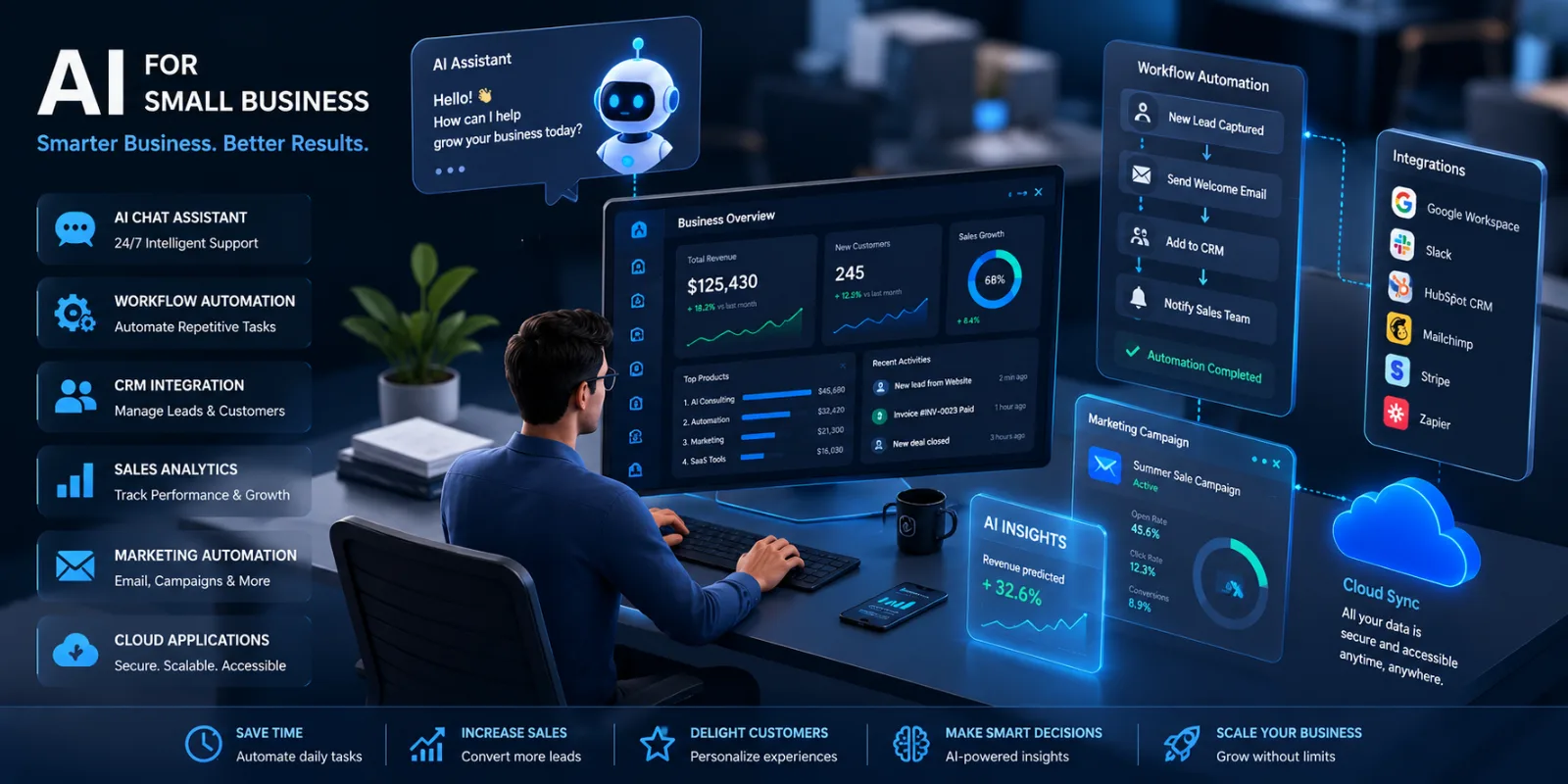
Discover the best AI use cases for small businesses. Learn how AI automates operations, improves customer service, increases sales, boosts productivity, and supports sustainable business growth.
Artificial Intelligence (AI) is no longer a technology reserved for large enterprises with dedicated research teams and multi-million-dollar budgets. Today, cloud-based AI platforms and intelligent automation tools have made AI accessible to startups, small businesses, and growing companies across every industry.
Whether you're managing a retail store, healthcare clinic, real estate agency, marketing firm, consulting business, or software startup, AI can automate repetitive tasks, improve customer experiences, increase productivity, and help your team accomplish more without significantly increasing operational costs.
For small businesses, the greatest advantage of AI isn't replacing employees—it's enabling smaller teams to work smarter. From answering customer enquiries and generating marketing content to forecasting sales and automating business workflows, AI has become a practical growth tool rather than an experimental technology.
In this guide, we'll explore the most valuable AI use cases for small businesses, the benefits they deliver, implementation best practices, and how organizations can begin adopting AI successfully.
Small businesses often face challenges that larger organizations can solve by simply hiring more staff or increasing budgets.
Common challenges include:
Artificial Intelligence helps overcome these challenges by automating routine work while providing intelligent insights that improve decision-making.
Businesses adopting AI often experience:
Rather than replacing human expertise, AI allows employees to focus on high-value work that contributes directly to business growth.
Customer support is one of the easiest and highest-impact AI implementations for small businesses.
Modern AI-powered chatbots and virtual assistants understand natural language, allowing them to provide helpful responses instead of relying on rigid decision trees.
AI customer support systems can:
Unlike traditional chatbots, modern AI assistants maintain context throughout conversations, creating more natural customer interactions.
Organizations implementing AI customer support typically achieve:
For many small businesses, AI chatbots provide the fastest return on investment.
Sales teams often spend valuable time identifying which enquiries deserve immediate attention.
AI can automatically analyze incoming leads using customer behavior, historical sales data, demographics, and buying intent.
AI-powered lead qualification helps businesses:
Sales representatives spend less time manually reviewing enquiries and more time engaging with qualified prospects.
This improves conversion rates while shortening the sales cycle.
Creating high-quality marketing content consistently can be difficult for small teams with limited resources.
AI significantly accelerates content production by assisting with:
AI should not replace human creativity, but it provides an excellent starting point that allows marketers to spend more time refining messaging and strategy.
The result is faster content production while maintaining consistent brand communication.
Email remains one of the highest-performing digital marketing channels.
Artificial Intelligence helps businesses optimize email campaigns through:
Rather than sending identical messages to every subscriber, AI enables businesses to deliver personalized communication that improves engagement and conversion rates.
Businesses that rely on appointments often spend significant time coordinating schedules manually.
AI scheduling assistants simplify the entire process.
They can:
Industries benefiting from AI scheduling include:
Automation improves customer convenience while reducing administrative workload.
Employees frequently spend valuable time searching for internal documentation instead of completing meaningful work.
AI knowledge assistants provide instant answers from company information.
Employees can ask questions such as:
Instead of manually searching documents, employees receive accurate answers within seconds.
Knowledge assistants improve productivity while reducing onboarding time for new employees.
Document processing consumes significant administrative time for many businesses.
Artificial Intelligence automates tasks such as:
Intelligent document processing reduces manual data entry while improving accuracy and operational efficiency.
Businesses process documents faster while minimizing human error.
Understanding future sales trends helps businesses make better financial and operational decisions.
AI-powered forecasting analyzes historical sales data, customer behavior, seasonal trends, and market conditions to predict future demand.
Businesses can use AI to:
Better forecasting enables small businesses to allocate resources more effectively while reducing unnecessary costs.
Maintaining a consistent social media presence requires significant time and creativity.
AI simplifies social media management by assisting with:
Rather than replacing marketers, AI helps them produce high-quality content faster while improving campaign performance.
Businesses can maintain consistent communication across multiple platforms without increasing workload.
One of the most valuable applications of Artificial Intelligence is workflow automation.
AI-powered workflows eliminate repetitive manual processes across departments.
Examples include:
Automated workflows reduce human error while improving operational efficiency.
Employees spend less time performing repetitive administrative work and more time focusing on strategic initiatives.
Artificial Intelligence delivers value across virtually every industry.
Retail businesses use AI for:
These capabilities improve customer experiences while increasing operational efficiency.
Healthcare providers implement AI to support:
AI helps healthcare professionals spend more time delivering patient care.
Real estate agencies use AI to:
Automation allows agents to focus on building client relationships.
Manufacturers apply AI for:
AI reduces downtime while improving operational performance.
Consulting firms, legal practices, accounting firms, and agencies use AI to automate:
These improvements increase productivity while enhancing client service.
Organizations implementing AI consistently experience measurable business improvements.
AI automates repetitive work, allowing employees to focus on customer relationships, innovation, and strategic planning.
Automation reduces manual effort, minimizes errors, and improves resource utilization without requiring significant increases in staffing.
AI enables faster responses, personalized communication, and consistent customer support across multiple channels.
AI analyzes large amounts of business data and generates insights that help leaders make informed decisions.
AI systems can support growing workloads without proportional increases in operational costs, making business expansion more sustainable.
Although AI offers significant benefits, businesses should prepare for several implementation challenges.
Common challenges include:
A strategic implementation plan helps organizations overcome these challenges while maximizing business value.
Successful AI adoption requires more than selecting the right software.
Businesses should follow several best practices.
Begin with one high-impact business problem rather than attempting enterprise-wide transformation.
Pilot projects reduce implementation risk while providing measurable results.
Establish measurable objectives before implementation.
Examples include:
Clear goals make it easier to evaluate AI performance.
Employees should understand:
Well-trained teams achieve significantly higher adoption rates.
Businesses should implement:
Responsible AI builds customer trust while reducing business risk.
Artificial Intelligence should be continuously evaluated.
Businesses should monitor:
Continuous optimization ensures AI continues delivering measurable value.
Artificial Intelligence continues evolving rapidly.
Emerging trends include:
Organizations adopting these technologies early will be better positioned for long-term success.
At MYST International, we help startups, small businesses, and enterprises successfully adopt Artificial Intelligence through practical, business-focused solutions.
Our expertise includes:
Rather than recommending technology for its own sake, we work closely with businesses to identify high-impact AI opportunities that improve productivity, reduce operational costs, and support sustainable growth.
From planning and development to deployment and ongoing optimization, our team delivers secure, scalable AI solutions tailored to your business objectives.
Artificial Intelligence is no longer a luxury reserved for large enterprises. It has become an accessible and practical business tool that enables small businesses to automate repetitive work, improve customer experiences, increase productivity, and make smarter decisions.
Whether you're implementing AI-powered customer support, automating internal workflows, improving marketing, or building intelligent business applications, the greatest value comes from solving real business problems rather than simply adopting the latest technology.
By starting with clearly defined objectives, investing in quality data, training employees, and continuously measuring results, small businesses can unlock the full potential of AI while building a strong foundation for long-term growth.
At MYST International, we help businesses transform innovative ideas into intelligent digital solutions that create measurable business value through Artificial Intelligence, automation, and modern software engineering.
Yes. Many AI solutions are available through cloud-based subscription services, making them affordable for startups and small businesses without requiring significant upfront investment.
Businesses should begin with repetitive, time-consuming tasks such as customer support, appointment scheduling, document processing, lead qualification, and internal reporting.
No. AI automates repetitive tasks and provides intelligent insights, allowing employees to focus on strategic, creative, and customer-facing responsibilities.
Yes. Modern AI solutions integrate with CRM systems, ERP platforms, accounting software, communication tools, cloud applications, and custom business software.
Implementation depends on project complexity. Simple AI chatbots and workflow automations can be deployed within weeks, while enterprise AI platforms may require several months.