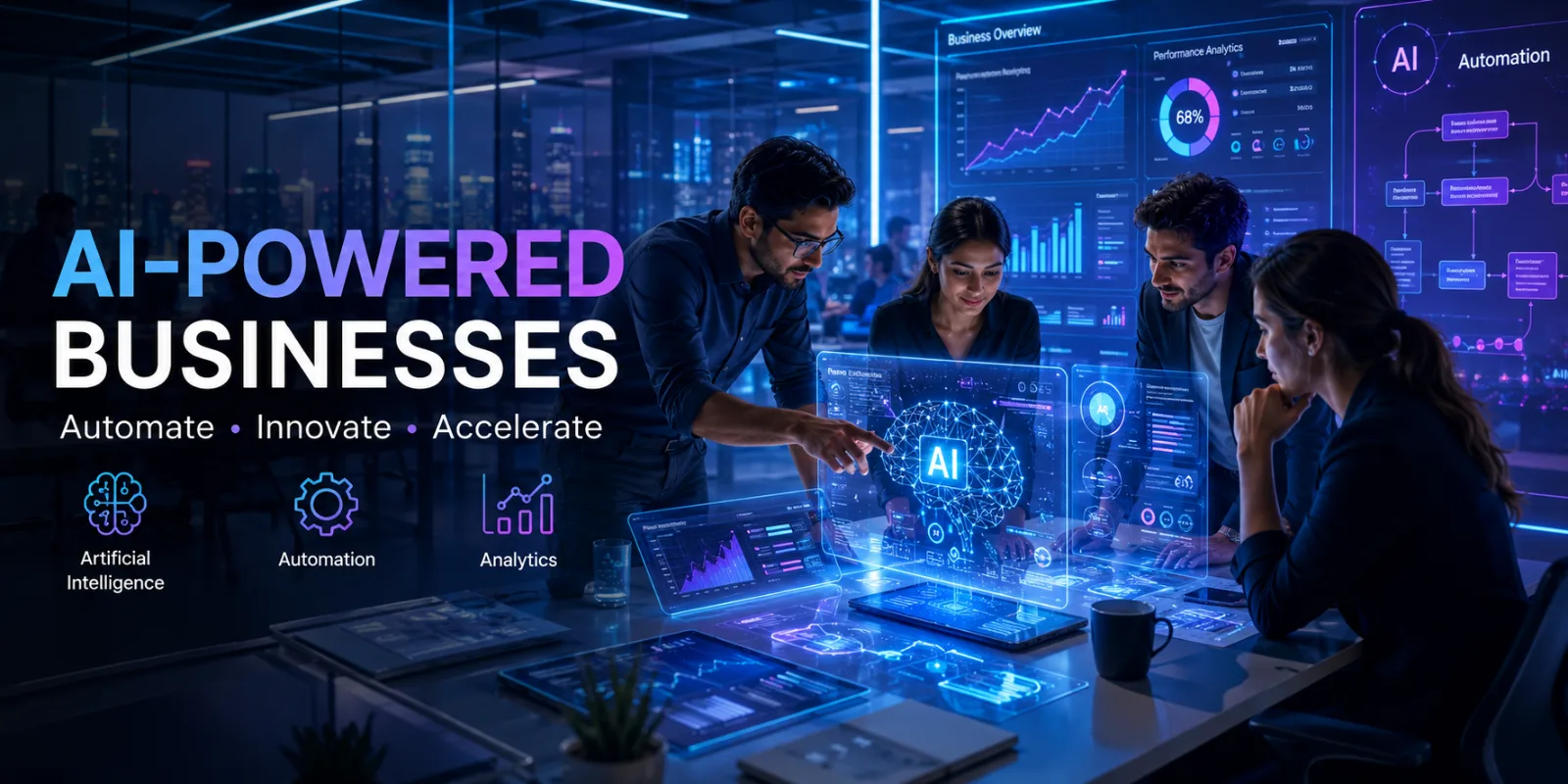
What separates AI-native startups from traditional tech companies, and how you can adopt their playbook.
Artificial Intelligence is no longer just a competitive advantage—it's becoming the foundation of how modern businesses innovate, scale, and compete. Across industries, AI-first companies are transforming customer experiences, automating repetitive operations, improving decision-making, and building products that continuously evolve with user needs.
What separates these companies from traditional businesses isn't simply their use of AI tools. It's their mindset. Instead of treating AI as an optional feature, they embed intelligence into every layer of their organization—from product development and marketing to customer support, operations, and business strategy.
For founders, entrepreneurs, and startup leaders, this shift offers valuable lessons. Whether you're launching a SaaS platform, building an eCommerce business, or creating the next innovative digital product, adopting an AI-first approach can help you move faster, reduce costs, and build a more resilient business.
In this guide, we'll explore five important lessons founders can learn from AI-first companies and how these principles can help create scalable, future-ready organizations.
An AI-first company is an organization that places Artificial Intelligence at the center of its products, internal operations, and strategic decision-making.
Rather than asking:
"Where can we add AI?"
AI-first organizations ask:
"How can AI improve every part of our business?"
This philosophy influences nearly every department, including:
The objective isn't to replace employees. Instead, AI helps people make better decisions, automate repetitive work, and focus on high-value activities that require creativity and critical thinking.
As AI technology continues to evolve, companies adopting this mindset are becoming more agile, efficient, and competitive.
One of the biggest mistakes startups make is adopting technology simply because it's popular.
Successful AI-first companies take the opposite approach.
They begin by identifying genuine customer problems before deciding whether Artificial Intelligence is the right solution.
For example, instead of saying:
"We need an AI chatbot."
They ask:
"How can we reduce customer response times while improving support quality?"
This subtle difference dramatically changes the outcome.
Technology should always support business goals—not define them.
By focusing on customer pain points first, AI-first organizations ensure every investment creates measurable value.
Problem-first thinking leads to:
Businesses avoid building unnecessary AI features that customers never use.
Instead, every technology investment directly contributes to solving meaningful business challenges.
Imagine two online retailers.
Company A builds an AI recommendation engine because competitors have one.
Company B first analyzes customer purchasing behavior and discovers shoppers struggle to find relevant products.
Only then does Company B implement AI recommendations.
The second company solves an actual customer problem rather than simply following industry trends.
Always start with customer needs.
Choose technology only after clearly understanding the problem you're trying to solve.
Artificial Intelligence depends on high-quality data.
Without accurate, consistent, and relevant information, even the most advanced AI systems produce poor results.
AI-first companies recognize data as one of their most valuable business assets.
Instead of treating data as something stored inside databases, they continuously improve its quality, organization, and accessibility.
These organizations invest in:
Every interaction becomes an opportunity to learn more about customers and improve products.
Good data enables businesses to:
As businesses grow, data becomes increasingly valuable because AI systems continuously learn from historical information.
An online retailer can analyze customer purchasing behavior to:
The better the underlying data, the more accurate the AI recommendations become.
Treat data like a long-term business investment.
Organizations with high-quality data gain a significant competitive advantage.
One of the greatest strengths of Artificial Intelligence is its ability to automate repetitive, time-consuming work.
AI-first companies understand that automation should enhance human capabilities—not replace them.
Instead of replacing employees, AI handles routine administrative tasks while people focus on creativity, innovation, strategic thinking, and relationship building.
Common automation examples include:
Removing repetitive work improves productivity across the organization.
Employees spend more time solving complex problems and creating value for customers.
Departments benefiting from automation include:
AI chatbots answer routine questions while support specialists handle complex issues.
AI qualifies leads, updates CRM systems, and schedules meetings automatically.
AI generates content ideas, segments audiences, and optimizes campaigns.
AI screens resumes, schedules interviews, and assists with employee onboarding.
AI automates invoice processing, expense management, reconciliation, and reporting.
These improvements allow organizations to accomplish significantly more without proportionally increasing headcount.
A small business owner spends three hours every day responding to repetitive customer inquiries.
After implementing an AI-powered customer support assistant, response times improve dramatically while employees focus on sales, customer relationships, and business growth.
Automation creates better experiences for both customers and employees.
Use AI to eliminate repetitive work—not human creativity.
The most successful businesses combine intelligent automation with human expertise to achieve the best results.
Traditional software often remains unchanged until developers release a new version. AI-powered products work differently. They continuously learn from user interactions, business data, and customer feedback, allowing them to become smarter and more valuable over time.
This ability to learn is one of the biggest competitive advantages of AI-first companies.
Instead of releasing a product and leaving it unchanged for months, these organizations use Artificial Intelligence to analyze user behavior and improve the customer experience automatically.
Examples include:
As more users interact with the system, AI models become increasingly accurate.
Businesses that continuously improve their products gain several advantages:
Customers are more likely to stay loyal to products that become more useful over time.
Streaming platforms continuously analyze viewing habits to recommend movies and TV shows that match each user's interests.
Similarly, an AI-powered customer support assistant improves its responses by learning from previous conversations and customer feedback.
Instead of requiring frequent manual updates, these systems become smarter through continuous learning.
Build products that learn from customers.
Continuous improvement creates long-term value while reducing the need for constant manual optimization.
Successful founders make decisions based on data—not assumptions.
AI-first companies use Artificial Intelligence to transform massive amounts of business data into actionable insights.
Instead of waiting for weekly or monthly reports, decision-makers receive real-time recommendations that help them respond quickly to changing market conditions.
AI can answer questions such as:
By combining predictive analytics with business intelligence, organizations can make faster and more confident decisions.
An online retailer uses AI to analyze purchasing trends before the holiday season.
Instead of manually forecasting inventory, the AI predicts customer demand based on previous sales, current market trends, and seasonal patterns.
The company orders inventory more accurately, reducing shortages and minimizing excess stock.
Treat AI as a decision-support system rather than simply an automation tool.
Better decisions lead to stronger business performance.
Although AI-first businesses operate in different industries, they often share several common characteristics.
Successful organizations typically:
These habits enable them to innovate faster while remaining competitive in rapidly evolving industries.
Adopting an AI-first mindset also presents challenges.
Understanding these obstacles helps businesses prepare for successful implementation.
AI systems depend on reliable, accurate, and consistent data.
Poor-quality data often produces inaccurate predictions and unreliable recommendations.
Organizations should invest in proper data management before deploying AI solutions.
Many businesses already use CRM software, ERP platforms, accounting systems, and marketing tools.
Connecting AI with existing infrastructure often requires:
Planning integrations early reduces long-term complexity.
Technology alone does not create transformation.
Employees must understand:
Providing training and encouraging experimentation helps teams embrace change.
Organizations using AI must protect sensitive customer and business information.
Important security practices include:
Building customer trust should remain a top priority.
Founders should define clear business objectives before investing in AI.
Useful performance indicators include:
Measuring results ensures AI investments continue creating business value.
If you're beginning your AI journey, start with small, measurable projects.
A practical roadmap includes:
Small successes often build momentum for larger digital transformation initiatives.
AI-first strategies are transforming nearly every industry.
Early adopters include:
As AI becomes more affordable and accessible, organizations of every size can benefit from intelligent automation.
Startups often have limited budgets, smaller teams, and intense competition.
Artificial Intelligence allows startups to compete through intelligence rather than size.
AI helps startups:
By embedding AI into their business strategy from the beginning, startups build stronger foundations for long-term growth.
At MYST International, we help startups, SMBs, and enterprises successfully adopt Artificial Intelligence through practical, scalable, and business-focused solutions.
Our expertise includes:
We focus on solving real business problems through secure, scalable, and future-ready AI technologies that deliver measurable results.
The world's most successful AI-first companies aren't winning because they simply use Artificial Intelligence—they're winning because they've built organizations that continuously learn, adapt, and improve. Their focus on solving real customer problems, leveraging high-quality data, automating repetitive work, and making evidence-based decisions creates sustainable competitive advantages.
For founders, adopting an AI-first mindset doesn't require rebuilding an entire business overnight. It starts with understanding where AI can deliver genuine value, implementing small but impactful improvements, and scaling those successes over time.
Businesses that embrace this approach today will be better positioned to innovate faster, operate more efficiently, and thrive in an increasingly AI-driven economy. At MYST International, we help organizations turn these principles into practical AI solutions that accelerate growth and prepare them for the future of business.
An AI-first company integrates Artificial Intelligence into its products, operations, and decision-making processes instead of treating AI as an optional feature.
Yes. Many small businesses begin with targeted AI projects such as customer support automation, workflow optimization, and intelligent data analysis before expanding AI across the organization.
No. AI works best when it enhances employee productivity by automating repetitive tasks while allowing people to focus on creativity, strategy, and customer relationships.
The biggest lesson is to solve real customer problems first and then use AI where it creates measurable business value.
Start by identifying one repetitive business process, implement an AI solution, measure the results, and expand gradually based on business impact.