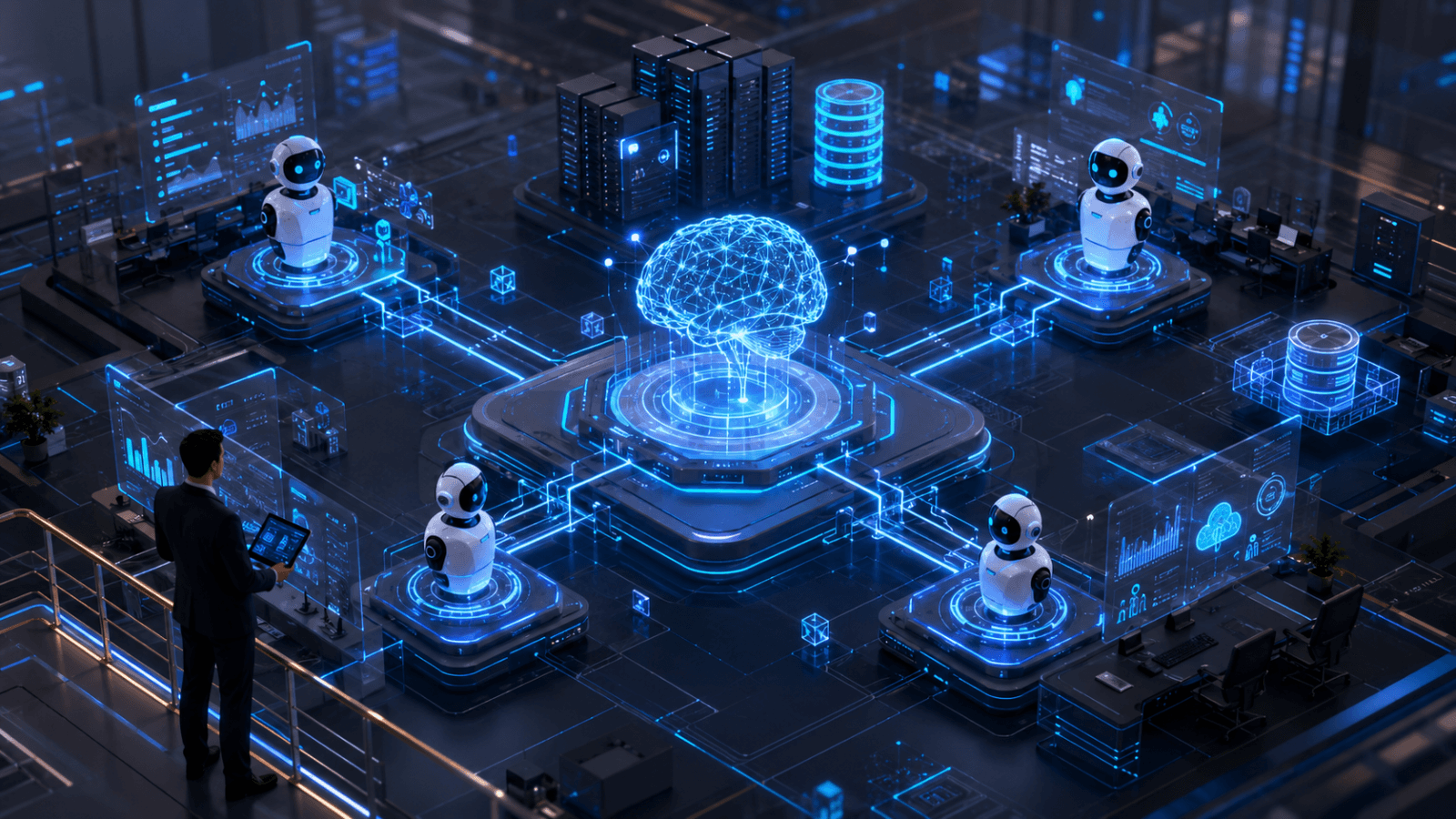
Discover how AI agent development enables businesses to build intelligent digital workers that automate complex workflows, connect business systems, improve customer experiences, and help teams work more efficiently.
AI Agent Development: How Businesses Can Build Intelligent Digital Workers
Introduction
Artificial Intelligence is moving beyond systems that simply answer questions. Modern businesses are increasingly exploring AI agents that can understand goals, retrieve information, use software tools, make decisions, and complete multi-step tasks.
An AI agent is an intelligent software system that can understand a goal, reason through the required steps, interact with external tools, and take actions to complete a task. Unlike traditional chatbots, AI agents can connect with business applications and participate in real workflows.
For example, a customer could ask an AI agent to check an order, identify a delivery issue, create a support ticket, and notify the appropriate team. The agent doesn’t simply provide information—it performs the workflow.
This shift is creating new opportunities for startups, SMEs, and enterprises looking to automate operations and build more intelligent digital products.
⸻
What Is AI Agent Development?
AI agent development is the process of designing, building, integrating, testing, and deploying AI-powered systems capable of performing tasks with varying levels of autonomy.
An AI agent can combine:
The result is an AI system designed around a specific business objective rather than a general-purpose conversation.
⸻
How Does an AI Agent Work?
A typical AI agent follows a cycle of understanding, reasoning, acting, and evaluating.
User Request
↓
Understand Intent
↓
Analyze Context
↓
Plan the Task
↓
Retrieve Information
↓
Select Tools
↓
Execute Actions
↓
Evaluate Result
↓
Return Response
For simple requests, the process may involve only a few steps. More advanced agents can coordinate multiple tools and systems to complete complex workflows.
⸻
What Is the Difference Between an AI Agent and a Chatbot?
An AI chatbot primarily focuses on conversation, while an AI agent is designed to accomplish a goal.
AI Chatbot AI Agent
Primarily responds to users Can complete tasks
Usually conversation-focused Goal-oriented
Limited tool usage Can use multiple tools
Often follows predefined flows Can dynamically plan steps
Usually provides information Can take actions
For example, a chatbot might answer:
“Your order is currently being delivered.”
An AI agent could:
That difference makes AI agents particularly valuable for business automation.
⸻
What Components Are Required to Build an AI Agent?
Large Language Model
The LLM provides the language understanding and reasoning capabilities needed to interpret requests and generate responses.
⸻
Tools and APIs
Tools allow an agent to interact with external systems.
An agent might use APIs to:
⸻
Knowledge Base
Business-specific information can be connected to an AI agent through documents, databases, internal systems, or knowledge bases.
⸻
Retrieval-Augmented Generation
RAG allows the agent to retrieve relevant information before generating an answer.
This is particularly useful when an AI agent needs access to:
RAG is therefore an important architecture for knowledge-intensive AI agents.
⸻
Memory
Memory enables agents to maintain relevant context across interactions.
Depending on the application, this can include:
Memory should be implemented carefully, particularly when handling sensitive business information.
⸻
Guardrails
AI agents should operate within defined boundaries.
Guardrails can control:
Human approval can remain part of the workflow for sensitive operations.
⸻
How Businesses Can Use AI Agents
Customer Support Agents
AI agents can handle common support workflows.
They can:
This can reduce repetitive work for customer support teams.
⸻
Sales Agents
AI agents can assist sales teams by:
Instead of manually moving information between systems, the agent can coordinate parts of the workflow.
⸻
HR Agents
Internal HR agents can help employees find information about:
A RAG-based architecture can allow responses to be grounded in approved company information.
⸻
Finance Agents
Finance workflows can involve large amounts of repetitive work.
AI agents can assist with:
Sensitive financial actions should include appropriate permissions and human oversight.
⸻
IT Support Agents
AI agents can help IT teams troubleshoot common issues.
For example, an agent could:
⸻
E-commerce Agents
E-commerce businesses can use AI agents to support customers throughout the shopping journey.
An agent could:
⸻
What Is a RAG-Based AI Agent?
A RAG-based AI agent combines Retrieval-Augmented Generation with agent capabilities.
The RAG component provides relevant knowledge.
The agent component decides what to do with that knowledge.
For example:
Customer Question
↓
AI Agent Understands Request
↓
Search Product Knowledge Base
↓
Retrieve Relevant Information
↓
Check Customer Account
↓
Take Appropriate Action
↓
Generate Response
This architecture is especially useful for enterprise applications where AI needs both knowledge and action.
⸻
Benefits of AI Agent Development
Automate Complex Workflows
AI agents can coordinate multiple steps instead of automating only one isolated task.
⸻
Improve Employee Productivity
Employees can delegate repetitive tasks to AI agents and focus on higher-value activities.
⸻
Provide Faster Customer Service
Agents can operate continuously and respond to common requests without waiting for human availability.
⸻
Connect Disconnected Systems
AI agents can act as an intelligent layer between different business applications.
⸻
Personalize User Experiences
Agents can use customer context and business information to provide more relevant interactions.
⸻
Scale Operations
Once properly designed, AI agents can handle large numbers of routine requests without requiring proportional increases in manual effort.
⸻
AI Agent Development Process
Building a reliable AI agent requires more than connecting an LLM to a chatbot interface.
Step 1: Identify the Business Problem
Start with a specific workflow or business challenge.
⸻
Step 2: Define the Agent’s Role
Determine exactly what the agent should and should not do.
⸻
Step 3: Identify Knowledge Sources
Determine which documents, databases, APIs, and systems the agent needs to access.
⸻
Step 4: Design the Architecture
Choose the appropriate:
⸻
Step 5: Develop the Agent
Build the reasoning, retrieval, tool-use, and workflow components.
⸻
Step 6: Add Security and Guardrails
Control access to business information and sensitive actions.
⸻
Step 7: Test Real Scenarios
Evaluate the agent against realistic business tasks, edge cases, and failure conditions.
⸻
Step 8: Deploy and Monitor
After deployment, monitor:
AI agents require continuous evaluation and improvement.
⸻
Common AI Agent Development Challenges
AI agents can create significant value, but organizations should understand their limitations.
Hallucinations
An agent may generate incorrect information if its knowledge or retrieval process is poorly designed.
RAG, validation, and appropriate guardrails can reduce this risk.
⸻
Incorrect Tool Usage
Agents may select the wrong tool or provide incorrect parameters.
Tool permissions and validation mechanisms are important.
⸻
Data Security
Enterprise agents may interact with sensitive information.
Access controls and data governance are essential.
⸻
Cost Management
Frequent LLM calls and complex agent workflows can increase operational costs.
Efficient prompts, model selection, caching, and workflow design can help control expenses.
⸻
Lack of Human Oversight
Not every task should be completely autonomous.
High-impact operations should include appropriate human approval.
⸻
AI Agents vs Traditional Automation
Traditional automation generally follows predefined rules.
AI agents can handle more flexible situations where the exact sequence of steps isn’t always known in advance.
Traditional Automation AI Agents
Rule-based Goal-oriented
Predictable workflows Dynamic workflows
Fixed logic Adaptive reasoning
Limited context Can use contextual information
Predefined actions Can select tools
This doesn’t mean AI agents should replace traditional automation everywhere. In many businesses, the best architecture combines deterministic automation with AI where flexibility and reasoning are useful.
⸻
When Should a Business Build an AI Agent?
An AI agent is worth considering when:
For simple, predictable tasks, conventional automation may be more appropriate.
⸻
How to Choose an AI Agent Development Company
When evaluating an AI development partner, consider:
AI Expertise
Look for experience with LLMs, RAG, AI agents, machine learning, and AI integrations.
Business Understanding
The development company should understand your workflow rather than simply build a generic chatbot.
Integration Experience
AI agents often need access to existing APIs, databases, CRM systems, and enterprise software.
Security
Ask how the company handles authentication, permissions, sensitive data, logging, and monitoring.
Evaluation
A reliable AI solution should be tested against measurable business scenarios before deployment.
Long-Term Support
AI applications require monitoring, evaluation, optimization, and model updates after launch.
⸻
Why MYST International Builds AI Agent Solutions
At MYST International, our AI expertise includes AI development, RAG solutions, intelligent automation, and custom software development. We help businesses connect AI capabilities with their existing digital systems to create practical solutions around real workflows.
Our AI agent capabilities can include:
The focus is not simply on building an AI chatbot. The objective is to create an intelligent system that can securely understand information, interact with business tools, and support measurable business outcomes.
⸻
Related Articles
⸻
Frequently Asked Questions
What is AI agent development?
AI agent development is the process of building intelligent software systems that can understand goals, reason through tasks, retrieve information, use external tools, and complete workflows.
What is the difference between an AI agent and a chatbot?
A chatbot mainly provides conversational responses, while an AI agent can use tools, access business systems, retrieve information, make decisions, and perform multi-step tasks.
Can AI agents use company data?
Yes. AI agents can access approved company information through databases, APIs, knowledge bases, and RAG architectures, provided appropriate security and access controls are implemented.
Can an AI agent integrate with a CRM?
Yes. With appropriate API access and permissions, an AI agent can retrieve customer information, update records, create tasks, and support sales or customer service workflows.
Are AI agents completely autonomous?
Not necessarily. The level of autonomy depends on the use case. Businesses can require human approval for sensitive or high-impact actions while allowing agents to operate independently for lower-risk tasks.
How much does AI agent development cost?
The cost depends on factors such as workflow complexity, integrations, data sources, model selection, security requirements, and deployment infrastructure. A simple internal agent and an enterprise multi-system agent can have very different development requirements.
⸻
Final Thoughts
AI agents represent an important evolution in business software. Instead of simply responding to questions, they can understand objectives, retrieve relevant knowledge, interact with applications, and coordinate multiple steps to complete real-world tasks.
The most effective AI agent projects begin with a clearly defined business problem rather than the technology itself. By combining LLMs, RAG, APIs, business data, automation, and appropriate human oversight, organizations can build intelligent systems that improve productivity and customer experiences while supporting sustainable growth.
For businesses exploring AI agent development, the next step is not to automate everything. Start with one valuable workflow, measure the results, learn from real usage, and expand the system as it proves its value.
AI agent development is the process of building intelligent software agents that can understand requests, reason about tasks, retrieve information, use tools and APIs, and take actions to complete business workflows with limited human intervention.
A chatbot primarily responds to user messages, while an AI agent can understand goals, plan multi-step tasks, access business systems, use tools, make decisions, execute actions, and evaluate results.
An AI agent typically requires a large language model, tools and APIs, a business knowledge base, retrieval-augmented generation, memory, agent orchestration, and security guardrails.
Businesses can use AI agents for customer support, sales, HR, finance, IT support, e-commerce, document processing, knowledge retrieval, workflow automation, and other repetitive or multi-step business processes.
A RAG-based AI agent combines retrieval-augmented generation with agent capabilities. It can search a business knowledge base for relevant information, access customer or operational data, use tools, and then generate a grounded response or take an appropriate action.
AI agent development can help businesses automate complex workflows, improve employee productivity, provide faster customer service, connect disconnected systems, personalize experiences, and scale operations more efficiently.
Common challenges include AI hallucinations, incorrect tool usage, data security risks, cost management, integration complexity, and the need for appropriate human oversight.
A business should consider building an AI agent when a workflow involves repetitive tasks, multiple systems, large amounts of information, frequent decisions, or multi-step processes that can benefit from intelligent automation.
Look for an AI agent development company with strong AI expertise, business understanding, integration experience, security practices, robust testing and evaluation processes, and the ability to provide long-term support.